



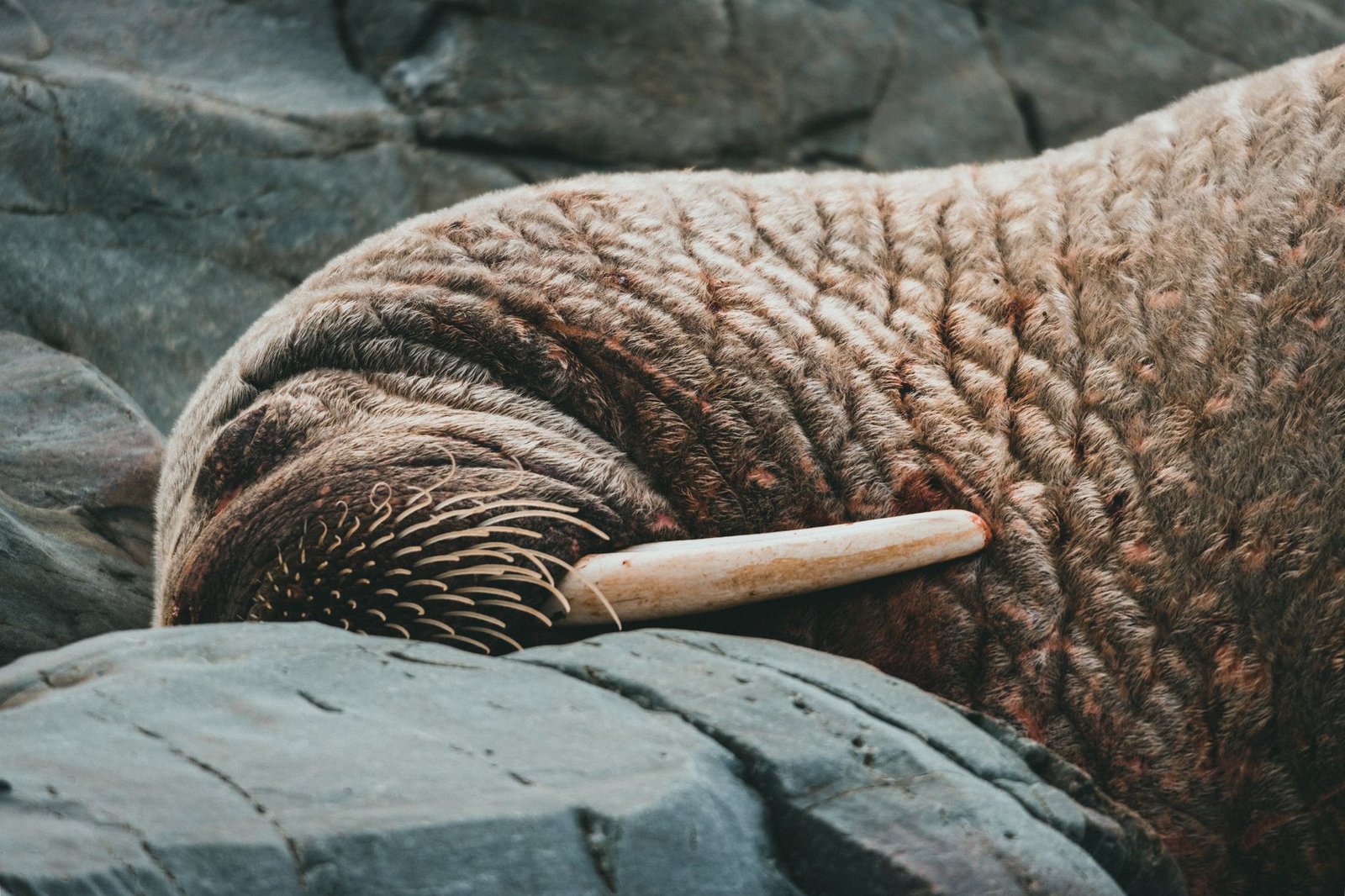
Imagine a creature of the deep that has fascinated humans for centuries, inspiring tales of mythical unicorns. This creature is real—the narwhal—and its famous **spiral tusk** is not only a biological marvel but a subject of intense scientific curiosity. Recent research reveals even more intriguing details about the structure of this enigmatic feature.

- The narwhal’s tusk is more than just a left-oriented spiral; it has an inner twist going the opposite way.
- This tusk is essentially a canine tooth protruding out of the male’s upper left jaw.
- While linked to **sexual selection**, the tusk’s function remains largely debated among scientists.
- Females often lack this tusk, which questions its significance in survival.
- New studies provide insights into narwhal tusk potential uses and its implications in **evolutionary biology**.
The Narwhal’s Tusk: A Science Unto Itself
Narwhals, often dubbed the “unicorns of the sea,” belong to the toothed whale family. Their iconic tusk is believed to be a highly evolved version of what we know as a canine tooth. Emerging from the upper left jaw, the tusk can grow between **1.5 to 2 meters**—an impressive feat of nature.
The study published in Nature Communications uncovers that the spiral seen externally on the narwhal’s tusk is complemented by a second internal spiral twisting in the opposite direction. This dual-spiral structure has left researchers intrigued, especially since it adds a new level of complexity to an already fascinating feature.
More Than Just Decor: The Role of Tusk in Social Hierarchies
In many animal species, specific physical traits evolve through **sexual selection**, where such characteristics give an advantage in attracting mates. The narwhal’s tusk is widely considered a symbol of **social status**, much like the peacock’s feathers. Though males are typically adorned with these lengthy spirals, females either possess a reduced version or none at all, pointing to the tusk’s non-essential role in survival.
Scientifically speaking, the paradox of the narwhal lies in the fact that females generally outlive males while lacking the symbolic tusk. This peculiar fact raises questions about its actual purpose and efficacy in terms of survival and reproduction.
Narwhals and Myths: A Historical Perspective
In Inuit folklore, the narwhal’s tusk comes from a woman who was transformed into such a whale after being dragged into the sea, with her hair turning into the twisted tusk. This imagination-rich narrative reflects the deep connections between human culture and natural history and how such beliefs persist even today.
Adding to the mystery, some males develop two tusks, a rare occurrence that opens further understanding into individual variations and genetic factors at play. Truly, the narwhal remains a creature that bridges the gap between imagination and reality.
Beyond Biology: Implications for Evolutionary Study
With such a complex and unique anatomical structure, the narwhal tusk provides valuable insights into **evolutionary biology**. Its development without clear advantages for survival or reproduction underscores an enigma, suggesting that further studies could illuminate the mysterious pathways of evolution.
Think of it like the “wingless” wings of an ostrich—existing in form, but not function. Such instances can guide AI researchers as they develop algorithms intended to mimic nature’s efficiencies and redundancies.
Looking Ahead: What This Means for AI
Understanding the narwhal’s tusk shines a light on the complexities involved in **biological evolution**, a field vastly rich in nuances that AI seeks to emulate. As technology advances, AI systems designed to model natural processes could potentially yield innovations in material science, architecture, and even social network analysis.
Looking to the future, those fascinating insights could foster new **biomimetic designs**, creating technologies that better serve humanity while preserving the ecological wonders that inspire them. Just as the narwhal continues to perplex and inspire us, so too do the endless possibilities of AI hold a future full of discovery and intrigue.
